Reader-First Marketing

HubSpot just dropped their 2026 Instagram engagement report. It's aimed at B2B (marketing to businesses) and B2C (marketing to consumers) brands, not authors, but the platform mechanics don't care what industry you're in. If you're an author trying to get your books in front of readers, this data applies to you too.
I went through the numbers, cross-referenced with Buffer and a few other sources, and pulled out what's actually useful. Here's what the data says, and what it means for you specifically.
The most important metrics to track for Instagram are watch time, like rate, and share rate -> aka, everything that shows how engaged your followers are with your account and your content. But overall, Instagram uses multiple different factors to decide what to show to whom:
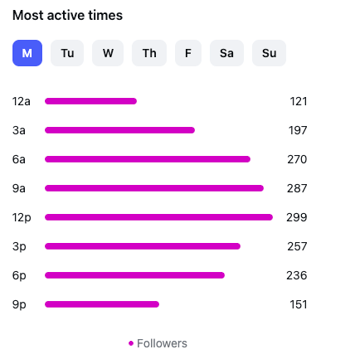
Instagram actually tells you this. Go to Dashboard > Insights > Account > Most active times on desktop. You get hourly and daily breakdowns for your specific audience (which will always be more useful than a universal average.
For my own account, 9am–12pm held up every day of the week, not just Tuesdays.
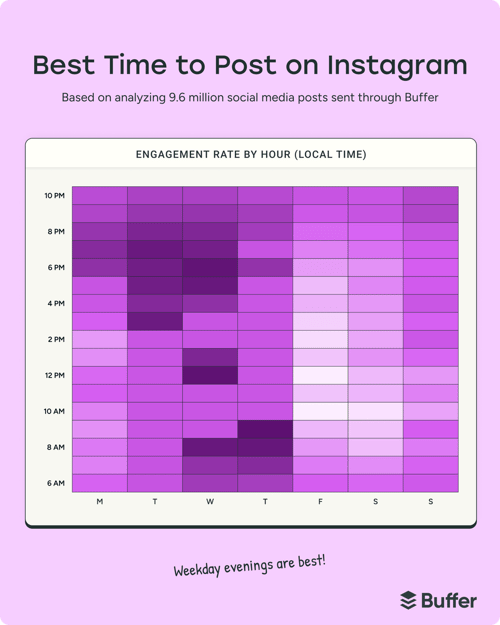
Buffer also put out a "best time to post on Instagram" heatmap and they are aligned on the weekday mornings, specifically, Thursdays at 9am. (btw, I have no idea why their heatmap goes backwards - 10pm to 6am 🤷)
There are 3 important aspects to Instagram: Feed and stories, explore page, and reels.
Feed and stories are designed to help you keep up with accounts you already know (in addition to seeing new accounts with similar content). The more you like a post from a specific account or comment on it, the more other posts from that same account you will see on your feed.
Interaction is the sign for the algorithm to push more of the same. So, if your followers reply regularly on your posts and stories (and you respond in return), the more likely it is that your followers will see your posts again and again and again.
The explore page is about discovering new accounts. The posts shown here are based on what else you tend to look at, save, or interact with, not based on if you follow that account.
Your posts will be shown here if they match a person's interests. To be shown, your existing posts popularity signals have to be strong as well. That includes likes, shares, saves, and comments, and ideally all of those early on after you posted.
Reels are meant for entertainment. And the more you watch a reel, the better. Important here are watch time, rewatches, shares, and audio clicks. If the algorithm sees strong engagement across these four, it will push your reel to new audiences (similar to the explore page). Important to note, reels are the best way of growing your community right now.
Reels get 36% more reach than carousels and nearly double the reach of a single image. As mentioned before, interaction is key. Instagram looks for the engagement of users with the reel, their history with the account (you), if it uses a trending audio, watch time, etc.
Here are some additional thoughts on what types of reels perform better:
In addition to reels, carousels and original content that uses trending audio are still better than static images.
Carousels—posts where users swipe through multiple images— see the highest engagement of all post types. 12% more than reels (no surprise, given you have to click to the next slide to see the rest of the post). Instagram recently bumped the carousel limit to 20 images, so lots to swipe through ;)
One thing worth knowing about static images and carousels: adding audio means the post will appear under reels. Without audio, image posts only show in the feed.
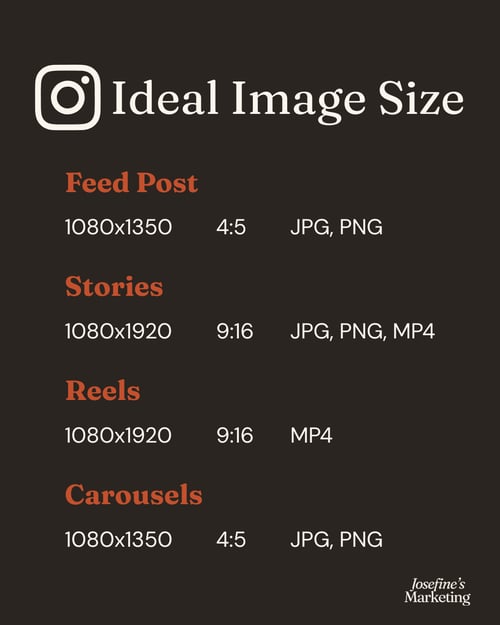
Also, check out Instagram's ideal image size to avoid cropping of your post.
 By the way, sharing your own image or reel to your stories doesn't change your overall reach. Instagram knows that this is your on post that you published already, plus, the feed has a higher reach than stories anyway.
Post whenever and whatever you can, right? Nope! While consistent posting is rewarded, posting too often can hurt your reach (we're not on Twitter... excuse me, X...).
Beyond frequency, Instagram does not want to recommend posts with:
The more focused and consistent your content is, the better the algorithm can match it to the right reader. Think of Instagram as a matchmaking service. Instagram is trying to match your posts to your readers, so those that love the same genre or niche. That's the easiest, if your posts and reels are all about the same topic.
Here's where I want to zoom out, because there's an important distinction between growing a following and reaching the right readers.
A lot of this data is about reach and engagement in the abstract. But your goal as an author isn't just gaining more followers. You want to find your next reader who is likely to pick up your book. That changes how you should weigh some of this.
You need different types of content for he different stages a reader is: those that don't know you yet, those that might have seen your content before but haven't bought anything, and your fans who have read your book and now want more. These are also your amplifiers on Instagram.
To attract net-new readers, those that are not familiar with your books yet and where you are trying to reel them in (no pun intended ;) ), they find you when Instagram pushes your content to their explore page. To get here, you need to know who your typical reader is and what other, similar content they consume. That then gives you ideas on what content you should be creating. For example, if I love enemies-to-lovers romance books (and that's what you write), look for other authors that write books with the same or similar tropes and take a look at their profile and take inspiration from them.
Now that someone found you, they want to get to know you and your books. That's where consistent posting comes in. To show up on their feed now, you have to keep posting, and it doesn't really matter if you post reels, carousels, or images (a good mix is ideal). As long as it is authentic and showing them who you are and what they can expect from your books. The key is building a relationship with them.
And lastly, those followers who have read your books and loved them will be the ones helping you be more visible. They want their friends to know about you and by sharing or reposting your content, they are stretching your reach to their followers. So, your content has to give them something that makes them want to do that. And I'm not necessarily talking giveaway posts or free stuff. Posts that show in an easy way what your book is about or a memorable quote can be as effective.
Work with the algorithm data, but make sure that what you actually put out there is in service of building real connection with readers.
HubSpot Instagram Engagement Report 2026
Buffer — The Best Time to Post on Social Media in 2026
Buffer — How the Instagram Algorithm Works: Your 2026 Guide
Buffer — Data Shows Instagram Reels are Best For Reach — But Not Engagement
Hey Orca — How the Instagram Algorithm Actually Works (2026)
Social Media Today — Human speech and presence help drive Reels engagement
Social Media Today — Instagram chief debunks popular engagement hack
Interested in getting more Marketing insights directly to your inbox? Sign up for the Reader-First Marketing newsletter here.